Structural Drying and Dehumidification in Greenbush, ME
Structural drying is the phase of water damage restoration that prevents long-term problems. After water is extracted from your home, significant moisture remains trapped inside wall cavities, subfloors, insulation, and wood framing. Water Damage Greenbush, ME uses commercial dehumidifiers, air movers, and daily moisture monitoring to dry your home to verified IICRC S500 standards. Call (207) 857-7378.
Why Structural Drying Matters More Than Extraction
Most homeowners focus on the visible water. That makes sense. Standing water on your kitchen floor is the obvious problem.
But here is what a lot of people miss: by the time you see standing water, moisture has already traveled into places you cannot see. Water wicks up drywall at a rate of about 1 inch per hour. It soaks through carpet padding into subfloors. It follows pipes and wiring channels into wall cavities. It saturates insulation that is pressed against wood framing.
Extracting the standing water removes the bulk of the problem. Structural drying removes everything that is left. If you skip this step, or try to handle it with household fans, you leave hidden moisture inside your walls and floors. That moisture feeds mold growth, warps wood, degrades drywall, and can cause structural damage over months and years.
For Greenbush homes built before 1980 with older construction materials, plaster walls, and fieldstone foundations, trapped moisture is especially damaging. These materials absorb and hold water more readily than modern building materials and take longer to dry.
How Does the Structural Drying Process Work?
Setting Up the Drying Environment
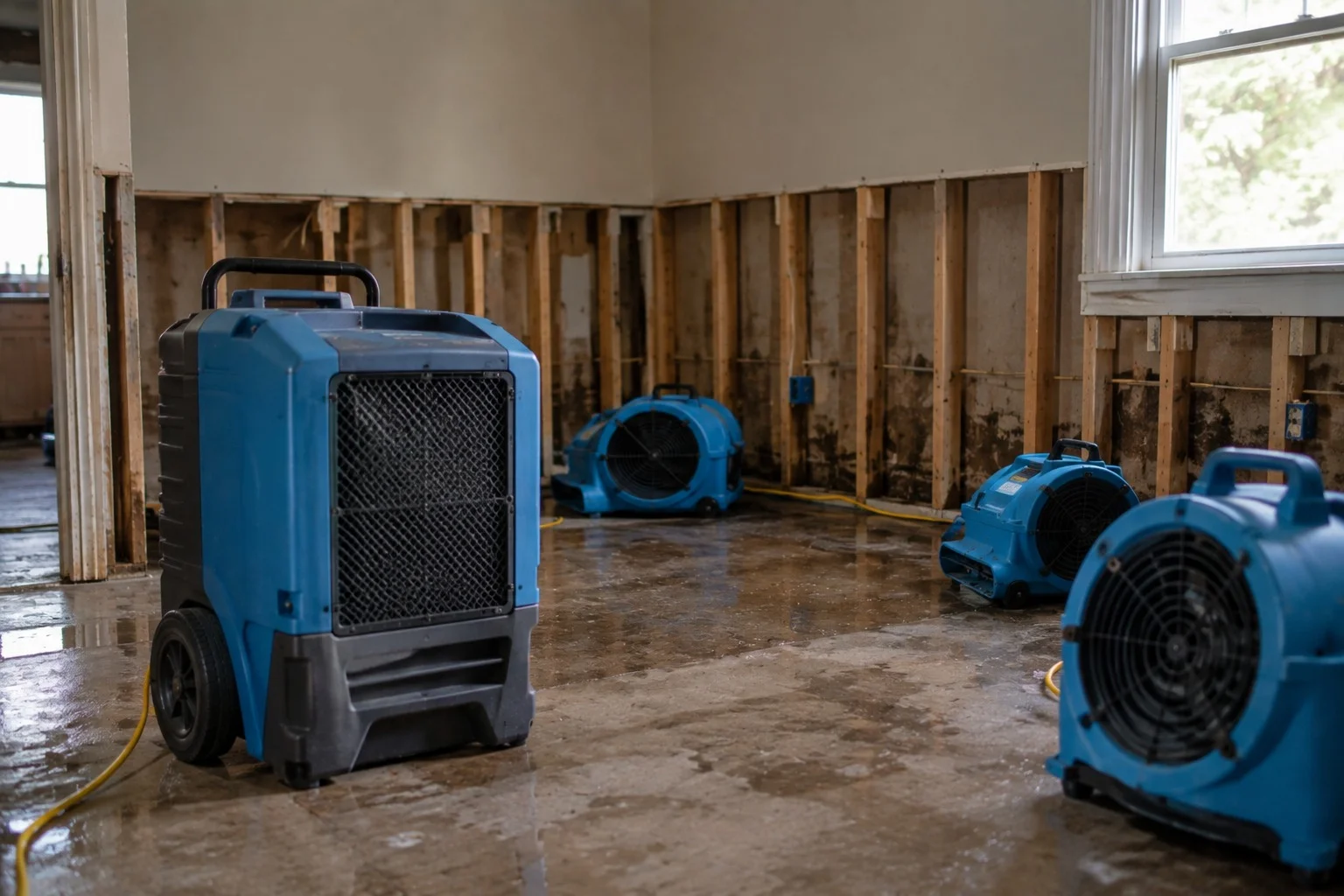
We create a controlled drying environment in the affected areas of your home. This involves three types of equipment working together:
Commercial Dehumidifiers
These are not the small units you buy at a hardware store. Commercial dehumidifiers intake humid air from the room, condense the moisture back into liquid form (which drains away through a line to a sink, sump, or outside), and push out hot, dry air. A properly sized commercial dehumidifier produces output air at around 90 degrees Fahrenheit and 22% relative humidity.
This hot, dry air is the engine that drives moisture out of wet building materials. Warm air holds more moisture than cool air. When the air surrounding a wet wall is hot and dry, water molecules in the wall move toward the drier environment. The dehumidifier then captures that moisture from the air and the cycle continues.
For below-grade spaces like basements, we often use desiccant dehumidifiers instead of standard refrigerant units. Desiccant systems work better in cooler environments and can achieve lower humidity levels, which is important in Greenbush basements where temperatures stay cool year-round.
Centrifugal Air Movers
These focused air movers (sometimes called “snails” in the industry) direct concentrated airflow along walls and across floor surfaces. By pushing air across wet materials, they accelerate the transfer of moisture from the material into the surrounding air.
We position centrifugal air movers at the base of wet walls, angled to push air up the wall surface. For wet ceilings, they can be angled upward. The focused airstream is more effective for wall drying than the broad airflow of a box fan.
Axial Air Movers
These larger fans produce higher CFM (cubic feet per minute) airflow across broader areas. We use them for open floor spaces, large rooms, and areas where carpet, padding, or hardwood flooring needs to release moisture. They are not directional like centrifugal movers. Instead, they create general air movement that keeps moisture circulating toward the dehumidifiers.
Wall Cavity Drying
When insulation has been removed from wall cavities during demolition, the open cavities need to be dried before new insulation and drywall are installed.
For cavities that are accessible (drywall already removed), we direct air movers into the open wall to dry the studs, bottom plates, and sheathing.
For cavities where we want to minimize demolition, we use injectidry wall drying systems. We drill small holes in the drywall and insert adapter ports. The system pushes warm, dry air directly into the wall cavity through these ports, drying the insulation and framing from inside without removing additional drywall.
The ports have holes on multiple sides, so we can direct airflow up, down, left, or right within the cavity. After drying is complete, the small port holes are easily patched during reconstruction.
Hardwood Floor Drying
Many Greenbush homes have hardwood floors over plywood subfloors. When water gets between the hardwood and the subfloor, the wood cups, buckles, and warps. If we catch it quickly, we can often save the flooring.
We use floor mat drying systems that lay flat on the hardwood surface. These mats create suction that pulls moisture out through the flutes and butt joints of the wood. Combined with the heat from our dehumidifiers, this draws trapped water from between the hardwood and the subfloor without removing the flooring.
If the hardwood can be dried before the wood fibers are permanently damaged, a professional sand-and-refinish after drying is often all that is needed, saving thousands compared to full floor replacement.
Daily Monitoring
This is where professional drying separates from DIY attempts.
Every day during the drying process, we return to your home and take readings with calibrated moisture meters and hygrometers. We measure:
- Material moisture content of drywall, wood framing, subfloors, and concrete using pin-type and pinless moisture meters
- Ambient relative humidity and temperature in the affected areas using hygrometers
- Surface temperature using infrared thermometers to identify cold spots where moisture may be lingering
We record these readings in a daily drying log. This log creates a drying curve that shows the progression from wet to dry over the course of the job. When readings reach the dry standard for each material (based on IICRC S500 guidelines and comparison with unaffected materials in the same home), we know that area is done.
We do not pull equipment based on how things look or feel. We pull equipment when the numbers confirm complete drying.
How Long Does Structural Drying Take?
Typical drying timelines for residential water damage in Greenbush:
- Single room, clean water, moderate moisture: 3 to 4 days
- Multiple rooms or extensive wall involvement: 4 to 5 days
- Basement or below-grade space: 5 to 7 days
- Major flood event with contaminated water: 5 to 10 days
Several factors affect drying time:
- Material type. Hardwood dries slower than drywall. Concrete slabs are the slowest.
- Ambient conditions. Basements in Greenbush run cooler than above-grade rooms, which slows evaporation. Desiccant dehumidifiers help compensate.
- Insulation type. Fiberglass insulation holds water differently than cellulose. Both require removal when saturated, but the surrounding materials absorb moisture differently.
- Air circulation. Rooms with limited airflow (closets, crawl spaces, utility rooms) dry slower. We add extra air movers to these areas.
How Much Does Structural Drying Cost?
Drying costs are typically included in the overall water damage restoration cost. Factors that affect the drying portion:
- Number and type of equipment units needed
- Duration of equipment operation (days)
- Daily monitoring visits
- Size of the affected area
As a general range, the drying phase of a residential water loss in Greenbush typically runs $1,500 to $4,000, depending on the number of dehumidifiers and air movers needed and the duration. This is separate from extraction, demolition, and reconstruction costs.
Your homeowners insurance typically covers drying equipment rental and monitoring as part of the mitigation phase of a covered water loss. We document all equipment placement, daily readings, and duration in our Xactimate estimate.
Need structural drying after water damage? Call (207) 857-7378. We bring the equipment and the monitoring, and we do not stop until the readings say done.